


Systemic listening therapy

Human development
Human development unfolds in relationships and communicative exchanges with one another. Hearing, which is dependent on communication, plays a special role in the human maturation process. Systemic Listening Therapy as an auditory treatment method can therefore effectively support these diverse processes.
Our sensory system receives and links information both from inside the body and from the outside world. We usually divide these into distant senses (e.g. sight and hearing) and near senses (e.g. the sense of touch). A special feature of our sense of hearing lies in its two sound conduction pathways, air conduction and bone conduction. The air conduction can be assigned to the distant senses. On the other hand, we perceive ourselves through the bone conduction, e.g. through our own voice. The sense of hearing is therefore both a distant sense and a near sense. It connects both worlds, the inside and the outside, self-perception and perception of the world.
The combination of all sensory systems creates a unity, a subjective reality, the person. Under favorable conditions, an integrative structure develops, both intrapsychically and interpersonally: a person with self-esteem who can enter into joyful and stimulating relationships with others and experience their existence in a meaningful way. A basic symbol for this process of perception, development and internalization is the spiral, which can also be found in the cochlea of the inner ear.
Intrauterine sounds
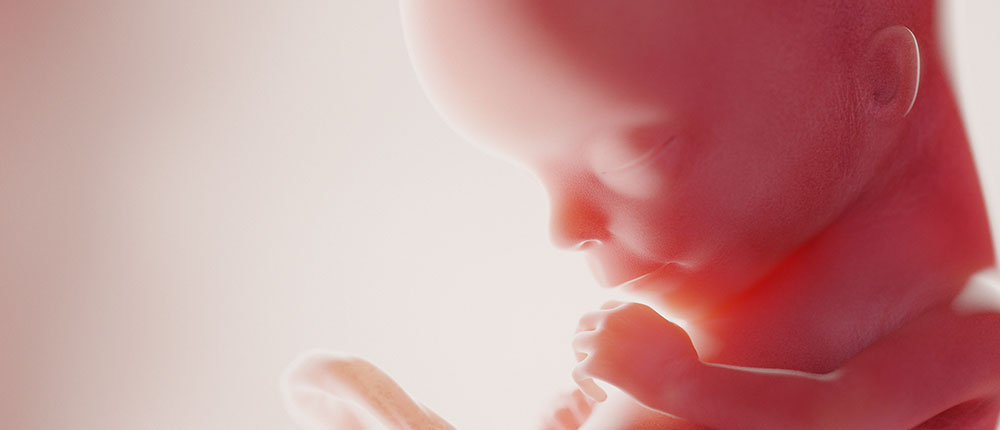
Intrauterine sounds
In the prenatal period, sound and rhythm shapes our development. In the sound space of the womb, the child experiences the sounds of the mother. The mother’s voice is particularly salient.
It arouses attention and interest. It predisposes us to language and the desire for human communication.
Physical, social and mental self-organization
As an organ of balance and hearing, the ear also combines two senses. It acts both as an outwardly directed and inwardly directed sense. The sense of balance organizes the body’s movement in space.
As described above, the sense of hearing also enables self-perception of the body, as we experience our voice through hearing. In this way, we discover and shape our means of communicative expression. Through hearing, we also grasp the outside world, the world with you. It expands our perception to the outside world and awakens the desire to take in information and communicate with others.
Listening Therapy

Because hearing is so important in the development of the human being, Systemic Listening Therapy can support a variety of development processes on a physical, psychological, mental and social level.
It supports people in their self-organizing, creative and communicative possibilities towards a higher level of self-integration.
Prof. Dr. Alfred Tomatis
Systemic Listening Therapy is the latest iteration of the listening therapy created by Dr. A. Tomatis in the second half of the last century. Dr. A. Tomatis was a French ENT specialist and had been investigated hearing and listening with cybernetic thought models since the 1950s.
He was the first to scientifically prove the connection between hearing and vocal sound (known today as the audiovocal loop). Another pioneering scientific achievement was the discovery and research into prenatal hearing. Dr. A. Tomatis called his research approach “Audio-Psycho-Phonology”.
This refers to the systemic connection between hearing, mental processing and communication. The experience gained in recent years with this method and new scientific findings have been incorporated into the Auris Integralis Systemic Listening Therapy concept.